Passwordless Authentication (2026)
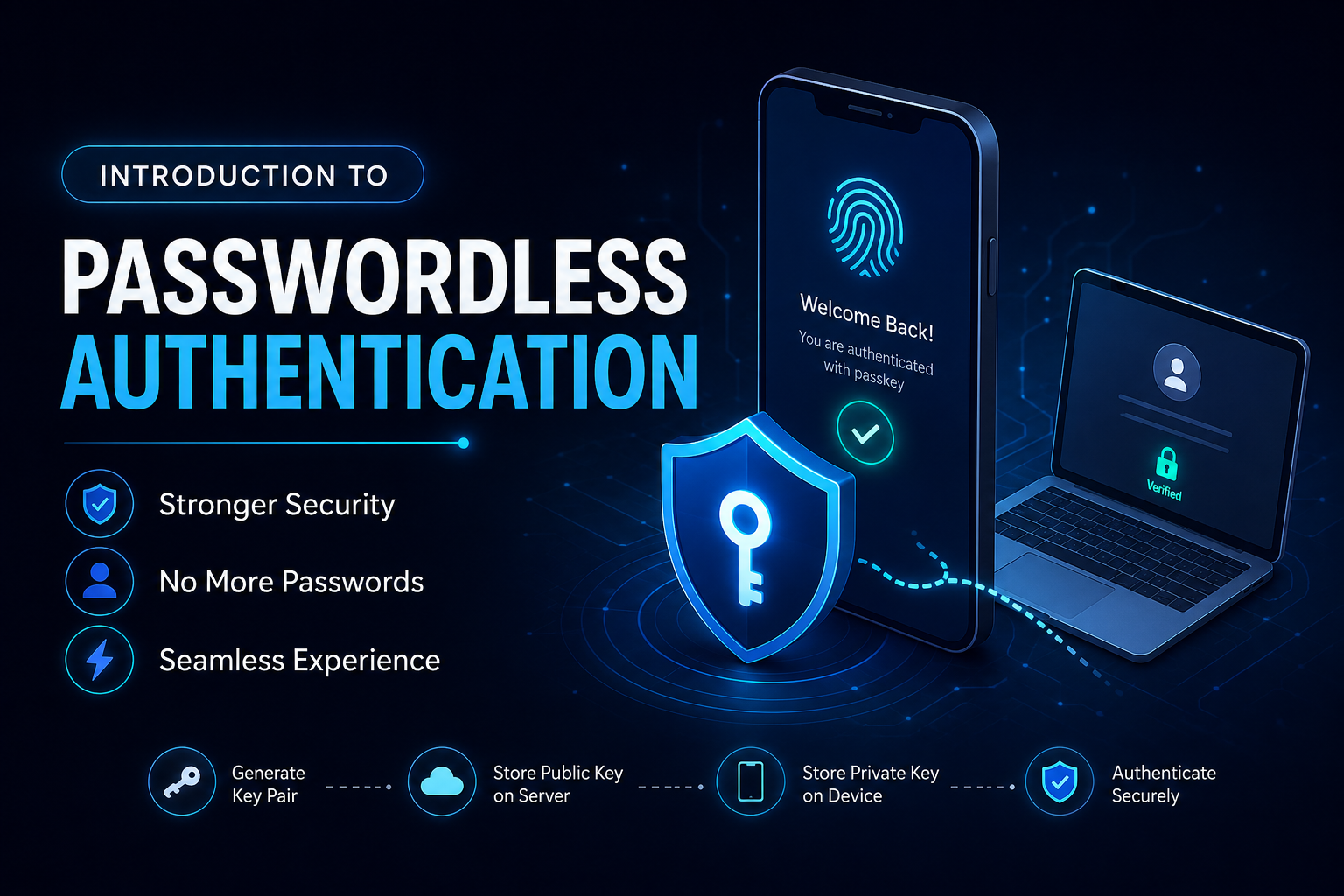
Introduction to Passwordless Authentication
Passwordless authentication, also known as passkey authentication, is a new way to authenticate online without using traditional passwords. According to Freedom of the Press Foundation, one of the most common ways people get hacked is through phishing, which can be prevented by using passkeys. In this guide, we will explore what passkeys are, how they work, and how to implement them.
Passkeys are a type of multi-factor authentication that uses public-key cryptography to verify a user's identity. They are resistant to phishing attacks because the private key is never transmitted over the internet. This means that even if an attacker intercepts the public key, they will not be able to use it to authenticate as the user.
Core Concepts / How Passwordless Authentication Works
Passkeys use public-key cryptography to authenticate users. When a user sets up a passkey, a pair of keys is generated: a private key stored on the user's device and a public key stored on the server. The private key is used to authenticate the user, while the public key is used to verify the user's identity.
import os
import hashlib

def generate_key_pair():
    # Generate a private key
    private_key = os.urandom(32)
    # Generate a public key
    public_key = hashlib.sha256(private_key).digest()
    return private_key, public_key
private_key, public_key = generate_key_pair()
print('Private Key:', private_key.hex())
print('Public Key:', public_key.hex())
Passkeys are resistant to phishing attacks because the private key is never transmitted over the internet. This means that even if an attacker intercepts the public key, they will not be able to use it to authenticate as the user.
According to Scalekit, passkeys power passwordless authentication using public-key cryptography. Understanding key creation, attestation, verification, and other concepts is crucial for implementing passkeys in a B2B SaaS application.
Step-by-Step Implementation of Passkeys
To implement passkeys, follow these steps:
- Generate a key pair using a library like WebAssembly.
- Store the private key on the user's device.
- Store the public key on the server.
- Use the private key to authenticate the user.
import os
import hashlib
import requests

def authenticate_user(private_key, public_key):
    # Authenticate the user using the private key
    authentication_token = hashlib.sha256(private_key).digest()
    # Verify the user's identity using the public key
    response = requests.post('https://example.com/verify', json={'public_key': public_key.hex()})
    if response.status_code == 200:
        return True
    else:
        return False
private_key, public_key = generate_key_pair()
if authenticate_user(private_key, public_key):
    print('User authenticated successfully')
else:
    print('User authentication failed')
import os
import hashlib
import requests

def register_user(private_key, public_key):
    # Register the user using the public key
    response = requests.post('https://example.com/register', json={'public_key': public_key.hex()})
    if response.status_code == 200:
        return True
    else:
        return False
private_key, public_key = generate_key_pair()
if register_user(private_key, public_key):
    print('User registered successfully')
else:
    print('User registration failed')
Real-World Example or Production Patterns
In a real-world scenario, passkeys can be used to authenticate users in a web application. For example, when a user logs in to a website, the website can use the user's passkey to authenticate them.
import os
import hashlib
import requests

def login_user(private_key, public_key):
    # Login the user using the private key
    authentication_token = hashlib.sha256(private_key).digest()
    # Verify the user's identity using the public key
    response = requests.post('https://example.com/login', json={'public_key': public_key.hex()})
    if response.status_code == 200:
        return True
    else:
        return False
private_key, public_key = generate_key_pair()
if login_user(private_key, public_key):
    print('User logged in successfully')
else:
    print('User login failed')
Passkeys can also be used in conjunction with other authentication methods, such as biometric authentication or two-factor authentication, to provide an additional layer of security.
Here are some benefits of using passkeys:
- Improved security: Passkeys use public-key cryptography, which is more secure than traditional passwords.
- Reduced risk of phishing attacks: Passkeys are resistant to phishing attacks because the private key is never transmitted over the internet.
- More seamless user experience: Passkeys eliminate the need for users to remember and enter passwords.
Best Practices & Gotchas
- Use a secure random number generator to generate the private key.
- Store the private key securely on the user's device.
- Use a secure protocol to transmit the public key to the server.
- Verify the user's identity using the public key.
- Use a secure authentication token to authenticate the user.
- Implement a secure password recovery mechanism.
FAQ
What are passkeys?
Passkeys are a new way to authenticate online without using traditional passwords.
How do passkeys work?
Passkeys use public-key cryptography to authenticate users.
Are passkeys secure?
Yes, passkeys are more secure than traditional passwords because they use public-key cryptography.
Can passkeys be used for password recovery?
No, passkeys should not be used for password recovery.
What are the benefits of using passkeys?
The benefits of using passkeys include improved security, reduced risk of phishing attacks, and a more seamless user experience.
How do passkeys compare to traditional passwords?
Passkeys are more secure than traditional passwords because they use public-key cryptography and do not require the user to remember a password.
What is the difference between passkeys and biometric authentication?
Passkeys and biometric authentication are both used for authentication, but they work in different ways. Passkeys use public-key cryptography, while biometric authentication uses unique physical characteristics, such as fingerprints or facial recognition.
Can passkeys be used in conjunction with other authentication methods?
Yes, passkeys can be used in conjunction with other authentication methods, such as biometric authentication or two-factor authentication, to provide an additional layer of security.
How do I implement passkeys in my web application?
To implement passkeys in your web application, you will need to generate a key pair, store the private key on the user's device, and store the public key on the server. You will also need to use the private key to authenticate the user and verify the user's identity using the public key.
What are some common use cases for passkeys?
Passkeys can be used in a variety of scenarios, including web applications, mobile applications, and IoT devices. They can also be used to authenticate users in a B2B SaaS application.
Conclusion
In conclusion, passkeys are a new way to authenticate online without using traditional passwords. They use public-key cryptography to authenticate users and are more secure than traditional passwords. By following the steps outlined in this guide, you can implement passkeys in your web application and provide a more secure authentication experience for your users.
Additional Considerations
When implementing passkeys, it's essential to consider the following additional factors:
- Key management: How will you manage the private and public keys?
- Key storage: Where will you store the private key?
- Key transmission: How will you transmit the public key to the server?
- Authentication protocols: What authentication protocols will you use to authenticate the user?
Implementation Examples
Here are some examples of how passkeys can be implemented in different programming languages:
import java.security.KeyPair;
import java.security.KeyPairGenerator;
import java.security.PrivateKey;
import java.security.PublicKey;

public class PasskeyExample {
    public static void main(String[] args) throws Exception {
        KeyPairGenerator keyGen = KeyPairGenerator.getInstance("RSA");
        keyGen.initialize(2048);
        KeyPair keyPair = keyGen.generateKeyPair();
        PrivateKey privateKey = keyPair.getPrivate();
        PublicKey publicKey = keyPair.getPublic();

        // Use the private key to authenticate the user
        String authenticationToken = privateKey.toString();

        // Verify the user's identity using the public key
        String publicKeyString = publicKey.toString();
    }
}
const crypto = require('crypto');

function generateKeyPair() {
    const keyPair = crypto.generateKeyPairSync('rsa', {
        modulusLength: 2048,
        publicKeyEncoding: {
            type: 'spki',
            format: 'pem'
        },
        privateKeyEncoding: {
            type: 'pkcs8',
            format: 'pem',
            cipher: 'aes-256-cbc',
            passphrase: ''
        }
    });
    return keyPair;
}

const keyPair = generateKeyPair();
console.log(keyPair.publicKey);
console.log(keyPair.privateKey);
Ad Space
Related Modules

DuckDB Async I/O Opt (2026)
Unlock efficient data processing with DuckDB asynchronous I/O optimization

Optimizing GCC Nested Functions (2026)
Discover the benefits of Optimizing GCC Nested Functions for efficient programming and learn how to implement them effectively.

Kubernetes Oxide integration (2026)
Learn how to integrate Kubernetes on Oxide for efficient container orchestration and discover the benefits of Kubernetes Oxide integration